Crystal Optics & Infrared Components
Deep UV to Long-Wave IR, Made in House
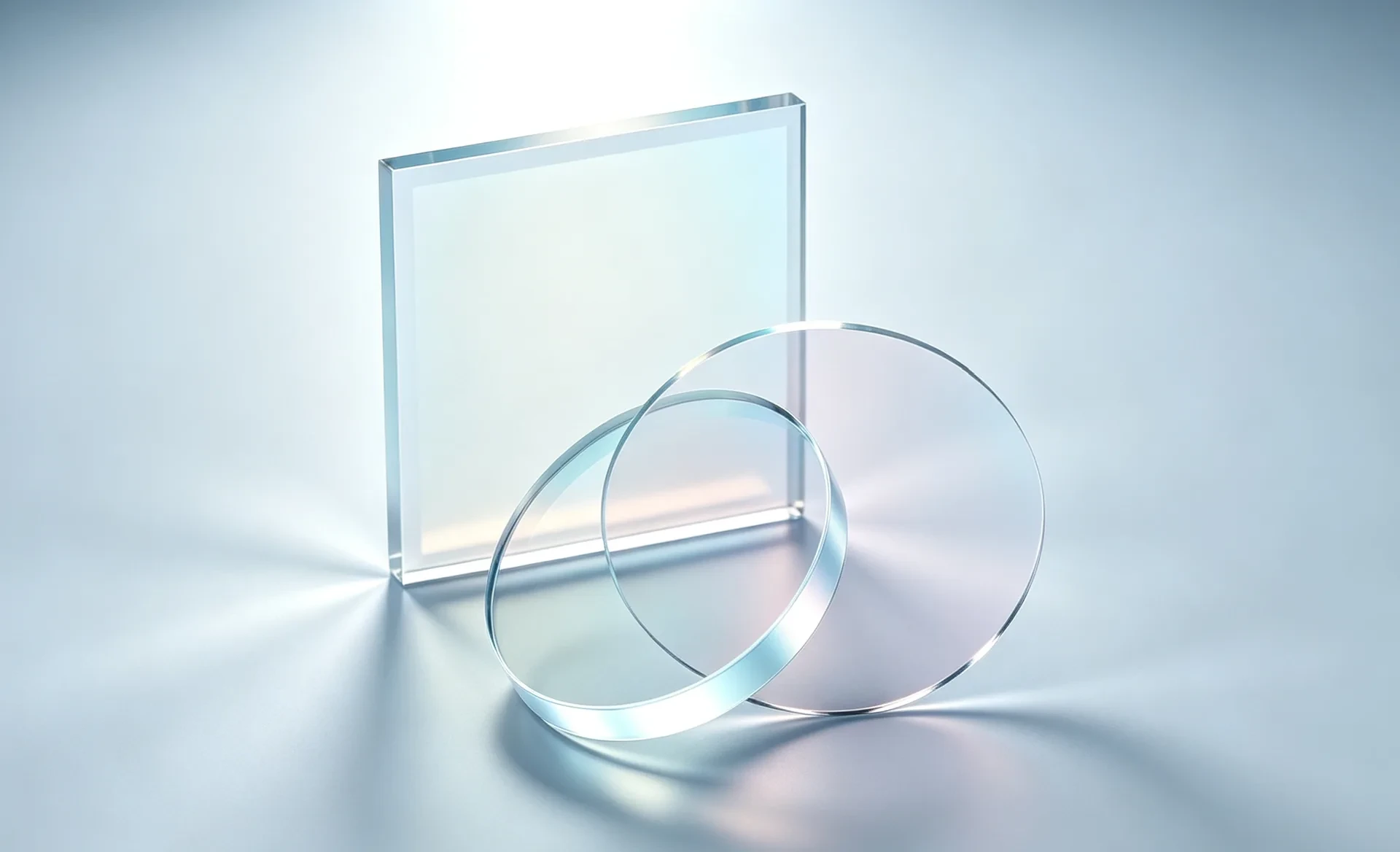
Crystal optics across the full spectrum, from deep ultraviolet to long-wave infrared. We manufacture infrared, ultraviolet, and nonlinear crystal components — windows, lenses, prisms, waveplates, and domes — from single prototypes through production volumes, with polishing and coating performed in the same facility.
Product Categories
Infrared Crystals
- ZnSe — CO2 laser optics and thermal imaging windows at 10.6 µm
- ZnS — FLIR-grade windows and domes for rugged IR sensors
- Silicon — MWIR imaging lenses, mirrors, and semiconductor optics
- Germanium — LWIR lenses and windows for uncooled and cooled detectors
UV & DUV Crystals
- CaF2 — Excimer optics at 193 nm and broadband UV-IR windows
- MgF2 — DUV windows, waveplates, and polarizers
- Sapphire — Harsh-environment windows with high laser damage resistance
- UV Fused Silica — Lithography and general UV optics
Nonlinear Crystals
- BBO — Deep-UV second and third harmonic generation
- LBO — High-power SHG and OPO pumping at 1064 nm
- KTP — Frequency doubling and optical parametric oscillation
Crystal Windows & Lenses
- Plano-convex and plano-concave lenses — Focusing and collimating IR beams
- Brewster-cut windows — Low-loss transmission at a defined polarization
- Wedges and prisms — Beam steering and dispersion control
- Domes — FLIR and airborne sensor protection
Specifying Your Crystal Optic
Material, transmission band, dimensions, flatness or radius, surface quality, and coating. For infrared work, tell us the detector type and operating temperature so the substrate can be matched to the band.
View Manufacturing Limits & Tolerance Chart2 specification tables on this page — copy every direct link in one go.
Crystal Material Specifications
Transmission values are quoted for 2 mm thickness. Refractive index is given at the wavelength most often used for that material. For a band-by-band shortlist, see the UV & DUV and MWIR & LWIR sections of the optical materials guide.
ZnSe
Transmission Range: 0.6-21 µm
Spectral Band: Visible – LWIR
Refractive Index: 2.40 at 10.6 µm
Typical Applications: CO2 laser optics, IR windows, thermal imaging
ZnS (FLIR grade)
Transmission Range: 0.4-12 µm
Spectral Band: Visible – LWIR
Refractive Index: 2.25 at 10.6 µm
Typical Applications: Rugged IR windows and domes, FLIR systems
Silicon
Transmission Range: 1.2-7 µm
Spectral Band: NIR – MWIR
Refractive Index: 3.42 at 4 µm
Typical Applications: MWIR imaging, laser mirrors, semiconductor optics
Germanium
Transmission Range: 1.8-23 µm
Spectral Band: NIR – LWIR
Refractive Index: 4.00 at 10.6 µm
Typical Applications: LWIR thermal imaging lenses, CO2 laser optics
CaF2
Transmission Range: 0.13-10 µm
Spectral Band: DUV – LWIR
Refractive Index: 1.43 at 1 µm
Typical Applications: Excimer laser optics, UV-VIS-IR windows
MgF2
Transmission Range: 0.12-8 µm
Spectral Band: DUV – MWIR
Refractive Index: 1.38 at 1 µm
Typical Applications: DUV windows, waveplates, polarizers
Sapphire
Transmission Range: 0.17-5.5 µm
Spectral Band: DUV – MWIR
Refractive Index: 1.75 at 1 µm
Typical Applications: Harsh-environment windows, high-fluence laser optics
UV Fused Silica
Transmission Range: 0.185-2.5 µm
Spectral Band: DUV – SWIR
Refractive Index: 1.46 at 1 µm
Typical Applications: 193 nm lithography, general UV optics
BaF2
Transmission Range: 0.2-11 µm
Spectral Band: DUV – LWIR
Refractive Index: 1.47 at 1 µm
Typical Applications: Spectroscopy windows, FTIR sample cells
Infrared Material Selection Guide
How the four common infrared substrates compare once weight, thermal load, and erosion resistance enter the decision.
ZnSe
Usable Band: 0.6-21 µm
Refractive Index: 2.40 at 10.6 µm
Typical Load: CW CO2 laser optics and thermal imaging; lowest absorption at 10.6 µm, but thermal lensing must be managed
ZnS
Usable Band: 0.4-12 µm
Refractive Index: 2.25 at 10.6 µm
Typical Load: Airborne domes and harsh-environment windows; resists thermal shock and sand erosion
Germanium
Usable Band: 1.8-23 µm
Refractive Index: 4.00 at 10.6 µm
Typical Load: LWIR imaging lenses; the high index gives strong power per element, at the cost of weight and heat sensitivity
Silicon
Usable Band: 1.2-7 µm
Refractive Index: 3.42 at 4 µm
Typical Load: High-power laser mirrors and MWIR windows; high thermal conductivity and low density
Surface radius scales with (n − 1) at a fixed focal length, so the germanium element runs flatter than the zinc selenide one: less sag across the same clear aperture means a thinner element, and one high-index element often replaces two. Density still counts — germanium at 5.33 g/cm³ and zinc selenide at 5.27 g/cm³ carry more mass per millimetre than silicon at 2.33 g/cm³, so check the drawing weight as well as the ray trace.
Manufacturing Capabilities
Diamond Turning
Single-point diamond turning shapes germanium, ZnSe, and silicon into aspheres, freeforms, and diffractive surfaces with roughness down to 5 Å rms.
Precision Polishing
Conventional grinding and polishing for flats and spheres, surface quality from 40/20 to 10/5 scratch-dig to MIL-PRF-13830B and surface accuracy down to λ/20 PV.
Integrated Coating
AR, DLC, and HR coatings deposited in-house on ZnSe, ZnS, germanium, and silicon, verified by adhesion and humidity testing to MIL-C-675 and ISO 9211.
Applications
Thermal imaging
MWIR and LWIR optics for cooled and uncooled detectors
Laser systems
CO2 at 10.6 µm, excimer at 193 and 248 nm, and solid-state lasers
Spectroscopy
FTIR windows, ATR crystals, and sample cells
Medical devices
Surgical CO2 laser optics and diagnostic instrumentation
Aerospace
Ruggedized IR windows and domes for airborne and spaceborne sensors
Frequently Asked Questions
For infrared work we supply ZnSe, ZnS including FLIR grade, silicon, germanium, and BaF2, plus sapphire and CaF2 for applications that span the near-IR into the visible. Components include windows, domes, lenses, prisms, and CO2 laser output couplers. Selection depends on your band, index, thermal load, and whether the part must survive abrasion or salt fog. Our material selection guide compares these substrates by transmission band, index, and typical load.
ZnSe transmits from about 0.6 µm to 21 µm, covering the visible red edge through the far-IR, which is why it is the usual choice for CO2 laser optics at 10.6 µm. ZnS in FLIR grade transmits from about 0.4 µm to 12 µm, with a shorter long-wave cut-off but better visible transmission. ZnS is harder and more resistant to thermal shock and abrasion, while ZnSe has lower absorption at 10.6 µm.
Yes. AR, BBAR, V-coat, DLC, and HR coatings are deposited in-house on ZnSe, ZnS, silicon, germanium, CaF2, and sapphire. Infrared designs are calculated for the actual angle of incidence and operating temperature, because the index of germanium and silicon shifts noticeably with heat. Durability is verified by adhesion and humidity testing to MIL-C-675 and ISO 9211.
Germanium, ZnSe, and silicon are shaped by single-point diamond turning, which produces aspheric and freeform surfaces with roughness down to 5 Å rms and leaves no polishing compound in the surface. Flats and spheres are ground and polished conventionally, with surface quality from 40/20 to 10/5 scratch-dig and surface accuracy down to λ/20 PV.
Silicon covers roughly 1.2-7 µm and is the lighter, harder option for MWIR imaging and laser mirrors, with high thermal conductivity that suits high-power systems. Germanium covers 1.8-23 µm with an index of 4.0 at 10.6 µm, which gives strong optical power in LWIR lenses but also makes it heavier, more thermally sensitive, and costlier. If weight or heat is the limiting factor, silicon or a chalcogenide design is usually the better starting point.
Related Components
Crystal parts are usually delivered coated: the optical coatings page covers AR, HR, and protective designs for ZnSe, ZnS, silicon, germanium, and CaF2, with the corresponding damage thresholds.

Request a custom crystal optics quote
Send your wavelength band, dimensions, and quantity for a technical review.
Request a custom crystal optics quote