Choosing Optical Materials by Wavelength: UV to LWIR
Material selection from the wavelength band inward: transmission windows, index and Abbe number, thermal behaviour and infrared process routes from BK7 to ZnSe.
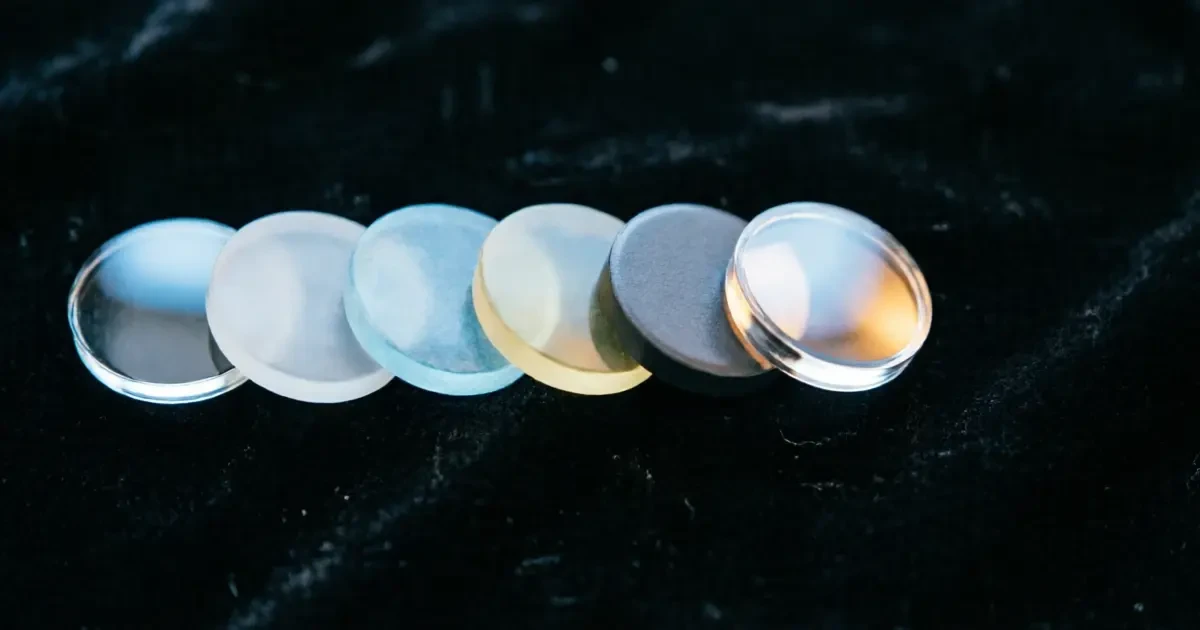
Material selection is the first irreversible decision in an optical design. Once the substrate is fixed, the transmission band, refractive index, dispersion, thermal behaviour and achievable surface quality are all constrained, and changing material later usually means re-optimising the prescription. Working outward from the wavelength band is the fastest way to narrow the field, and this note sets out what each substrate family actually buys you.
Start with the transmission window
Every optical material is transparent only within a band, and the usable band is narrower than the published window because absorption near the edges degrades both transmission and wavefront. The table below gives the practical ranges we work in, together with the index and dispersion figures that drive first-order design.
| Material | Practical transmission | Index (nd) | Abbe number | Typical use |
|---|---|---|---|---|
| BK7 | ~330 nm – 2.0 µm | 1.517 | 64 | Visible and NIR lenses, windows |
| UV fused silica | ~185 nm – 2.1 µm | 1.459 | 68 | Deep UV, high-power laser, prisms |
| CaF2 | ~130 nm – 8 µm | 1.434 | 95 | Excimer optics, IR imaging, low dispersion |
| MgF2 | ~120 nm – 7 µm | 1.38 (ordinary) | — | UV windows, birefringent elements |
| Sapphire | ~0.17 – 5.5 µm | 1.77 | — | Harsh environments, high hardness, IR domes |
| ZnSe | ~0.6 – 21 µm | 2.40 | — | CO2 laser optics, thermal imaging |
| Germanium | ~2 – 17 µm | 4.00 | — | LWIR imaging, high-index IR systems |
| Silicon | ~1.2 – 7 µm | 3.42 | — | MWIR optics, lightweight IR windows |
Two cautions apply to this table. Index values are quoted at the sodium d-line unless stated otherwise, and they move by several parts in the fourth decimal place across the visible, which matters for high-numerical-aperture designs. And transmission windows describe bulk material, not coated parts: a substrate that transmits at 200 nm may still be limited by the coating, the cement or the mount.
Use dispersion to solve colour, not just transmission
Where chromatic behaviour matters, Abbe number is the controlling figure. BK7 at 64 is a crown; high-index flints sit in the 25–35 range. An achromatic doublet pairs the two so that the crown's positive power and the flint's negative power cancel first-order colour, which is why doublets are the standard answer for broadband imaging from 400 to 700 nm. Our spherical lens range includes cemented doublets built on exactly this principle.
Wide bands need more than two materials. A triplet or a four-element design distributes colour correction across several glasses, and at that point the design becomes a glass-selection problem as much as a layout problem. If your band runs from 400 to 1000 nm, a doublet will not hold focus across the whole range; specify the band and let the design determine the element count.
For dispersive prisms the requirement is different again: you want high dispersion and good homogeneity, so flint glasses, CaF2 and fused silica each serve different roles. Our prism work covers both beam-steering prisms, where dispersion is a nuisance, and dispersive prisms, where it is the function.
Thermal behaviour decides stability, not just survival
Two coefficients matter. Thermal expansion moves the mechanical stack; the temperature coefficient of refractive index moves the focus. BK7 expands at roughly 7 × 10⁻⁶/K, fused silica at about 0.5 × 10⁻⁶/K, CaF2 at around 19 × 10−6/K and sapphire around 5–8 × 10⁻⁶/K depending on axis. A design that must stay in focus across a 60 K swing has a materially different material problem from one that runs in a temperature-controlled enclosure.
For athermalised systems the usual approach is to balance a positive dn/dT element against a negative one, or to choose a low-expansion substrate and absorb the residual in the mount. Both strategies need the temperature range declared at design stage, because the correction is applied in the prescription, not in the hardware.
Hardness, chemical resistance and coating compatibility
External windows in industrial environments are usually limited by abrasion and cleaning rather than by transmission. Sapphire is the default answer where scratch resistance dominates; fused silica is preferable where UV transmission dominates; CaF2 is soft and slightly soluble, so it belongs behind a protective window unless the application demands otherwise. Coatings behave differently on each substrate as well: adhesion and stress depend on surface chemistry, and a coating developed for BK7 is not automatically transferable to CaF2 or ZnSe.
Declare the cleaning regime with the material choice. Repeated solvent wiping, ultrasonic cleaning and humidity exposure all constrain the substrate and coating combination, and the constraints are easier to accommodate at quotation than at final inspection. Our flat optics range covers windows, mirrors and beam splitters where these environmental requirements are usually the deciding factor.
Infrared materials need a different manufacturing route
Beyond roughly 2.5 µm the material set changes and so does the process. Germanium, silicon, ZnSe and chalcogenide glasses are crystalline or amorphous materials that are generally single-point diamond turned rather than polished, because they machine to optical finish with a deterministic tool path. That gives excellent form and roughness — down to 0.2 µm RMS form and Ra 1 nm in our diamond turning cell — but it also constrains geometry: the surface must be a figure of revolution or a slow freeform, and the tool leaves a characteristic directional texture that matters for scatter-sensitive systems.
Thermal effects are larger in the infrared, too. Germanium's index changes strongly with temperature and its absorption rises with temperature, so high-power CO2 systems need the thermal lens designed in. If the application involves kilowatt-class IR lasers, say so at the start; it changes both material and coating.
A practical selection sequence
- Define the band and the transmission target through the full optical path, not per element.
- Fix index and Abbe constraints from the first-order design and the colour budget.
- Check thermal range: expansion, dn/dT and any athermalisation strategy.
- Check environment: abrasion, cleaning, humidity, laser fluence.
- Confirm manufacturing route and achievable surface quality, then tolerances.
- Only then select the coating, since coating design depends on substrate and band together.
Running the sequence in that order usually narrows the choice to two or three candidates, and the final decision is then made on availability and cost rather than on performance. The optical materials selection guide compares the same substrates by band, index, and application, and our manufacturing team confirms stock and qualification data before the drawing is released.
Not sure which substrate suits your wavelength band? Send your drawing, specification or beam profile and our engineering team will review it and reply with a quotation.Ask our optical engineers
Frequently Asked Questions
Is BK7 suitable for near-infrared work?
Yes, up to roughly 2 µm. BK7 is transparent and low-cost across the visible and near-infrared and remains the default substrate for 780–1550 nm systems. Above about 2 µm, absorption rises and you should move to fused silica, sapphire or an infrared material depending on the exact band.
Why is CaF2 used in excimer optics?
Because it combines deep ultraviolet transmission down to about 130 nm with low dispersion and good homogeneity, and because it withstands 193 nm exposure better than most alternatives. It is soft and mildly soluble, so handling and cleaning procedures matter more than for fused silica.
Can you cement different materials into one assembly?
Yes. Achromatic doublets and triplets routinely pair a crown with a flint, and prism assemblies are cemented where the interface can be made optically contacted or bonded. The material pair must be declared at design stage because differential expansion drives stress in the bond line.
Which materials can be diamond turned rather than polished?
ZnSe, ZnS, germanium, silicon, chalcogenide glasses and polymers such as PMMA and COC machine well by single-point diamond turning. Visible-range glasses are normally polished, since diamond turning leaves tool marks that are unacceptable at short wavelengths.
How much does material choice affect lead time?
Substantially, when the material is not in routine stock. BK7 and UV fused silica are usually available immediately; CaF2, sapphire and infrared crystals are often ordered to size, which adds weeks before machining begins. Confirming material availability at quotation stage is the simplest way to protect a schedule.