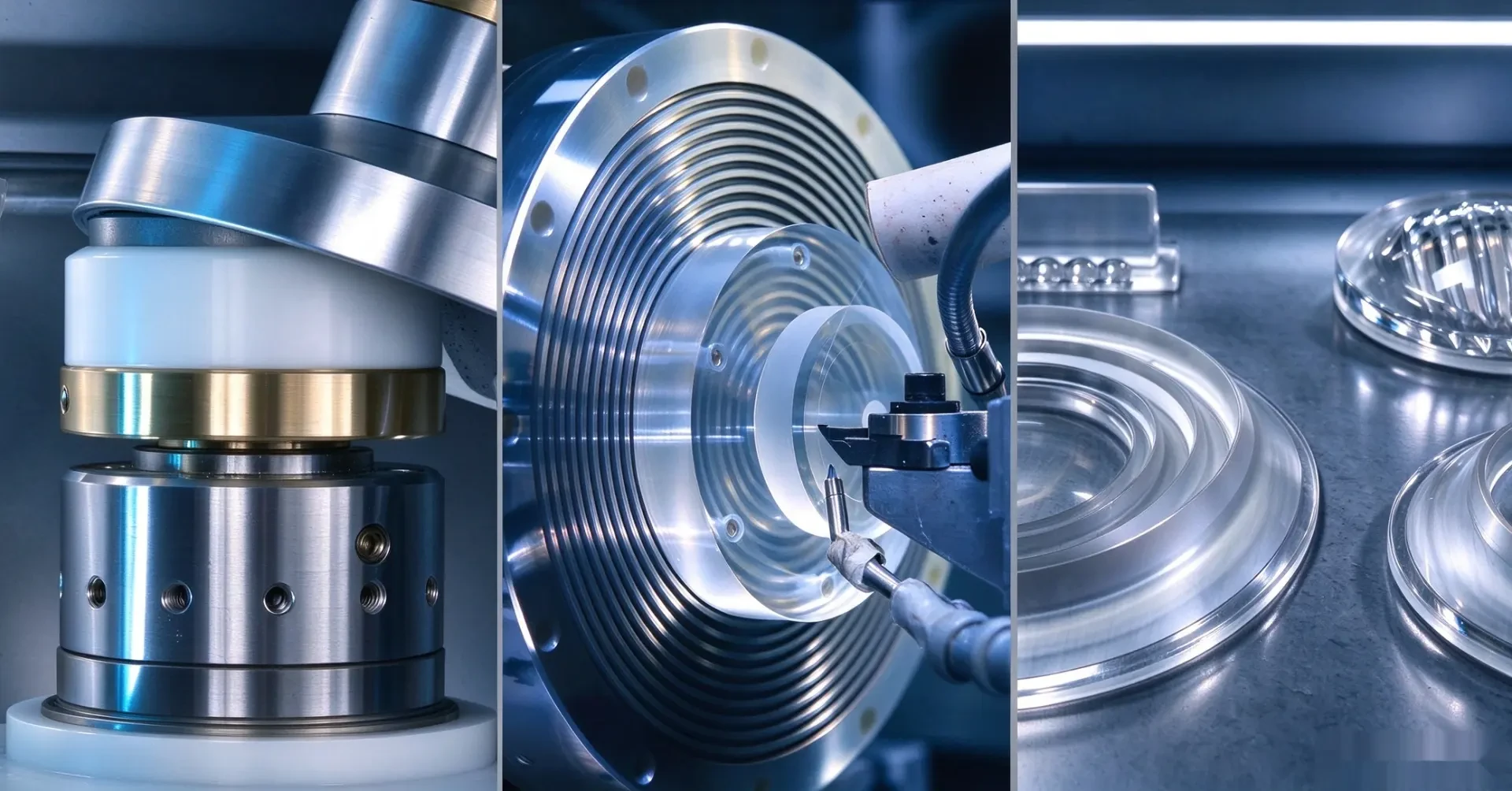
Why In-House Manufacturing Shortens Optical Development Cycles
Why keeping polishing, coating, cementing and metrology in one facility surfaces problems earlier and changes how prototype and production schedules behave.
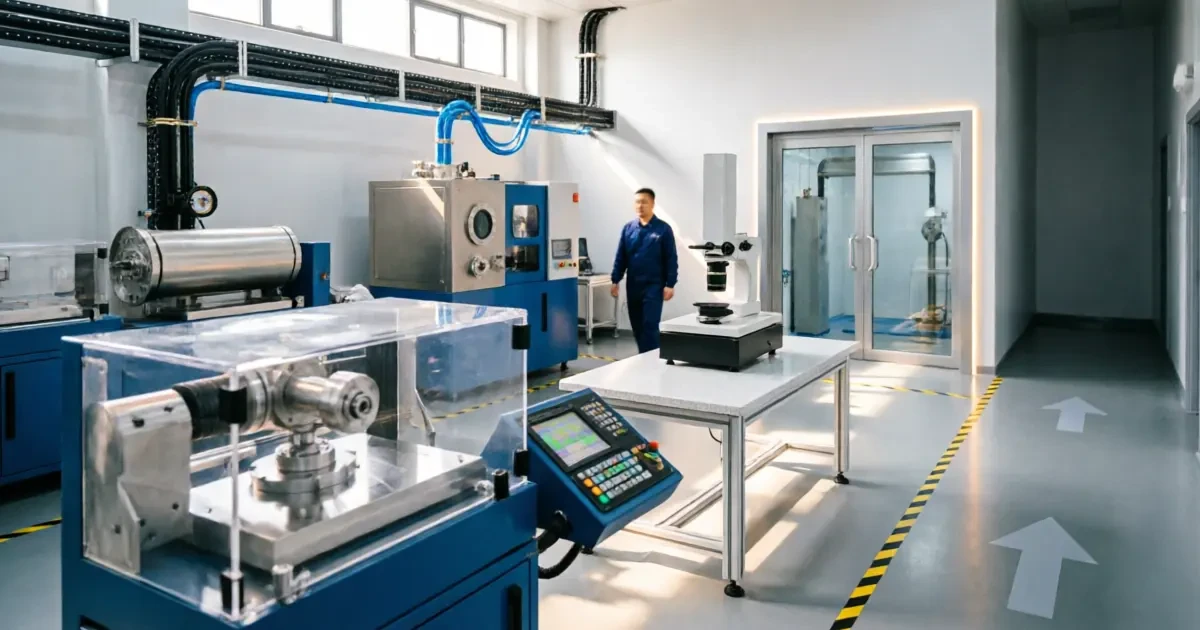
Optical programmes fail on interfaces more often than on any single process. When design, polishing, coating, cementing and inspection sit in different organisations, every interface becomes a place where a requirement can be reinterpreted and a defect can be attributed to someone else. Keeping those steps in one building does not make the physics easier, but it changes how quickly a problem is found and how much it costs to fix.
Problems surface earlier, when they are cheap
A design assumption that cannot survive manufacturing usually announces itself in one of three ways: a polishing run that converges slowly, a coating that will not meet its spectral target on the chosen substrate, or an assembly that fails centration after cementing. In a split supply chain, each of those signals appears at a different supplier, weeks apart, and each is reported as a specification issue rather than a process issue. In an integrated flow, the same signal appears at the next process step, with the part still in hand and the responsible engineer a corridor away.
The economics are straightforward. Rework at the polishing stage costs a polishing cycle; rework discovered after coating costs the polishing cycle plus the coating run plus the risk that stripping the coating damages the surface; rework discovered at the customer costs the part, the schedule and the relationship. Early detection is the single largest cost lever in custom optics, and it is a function of organisational distance rather than of equipment.
Design for manufacture becomes a real review
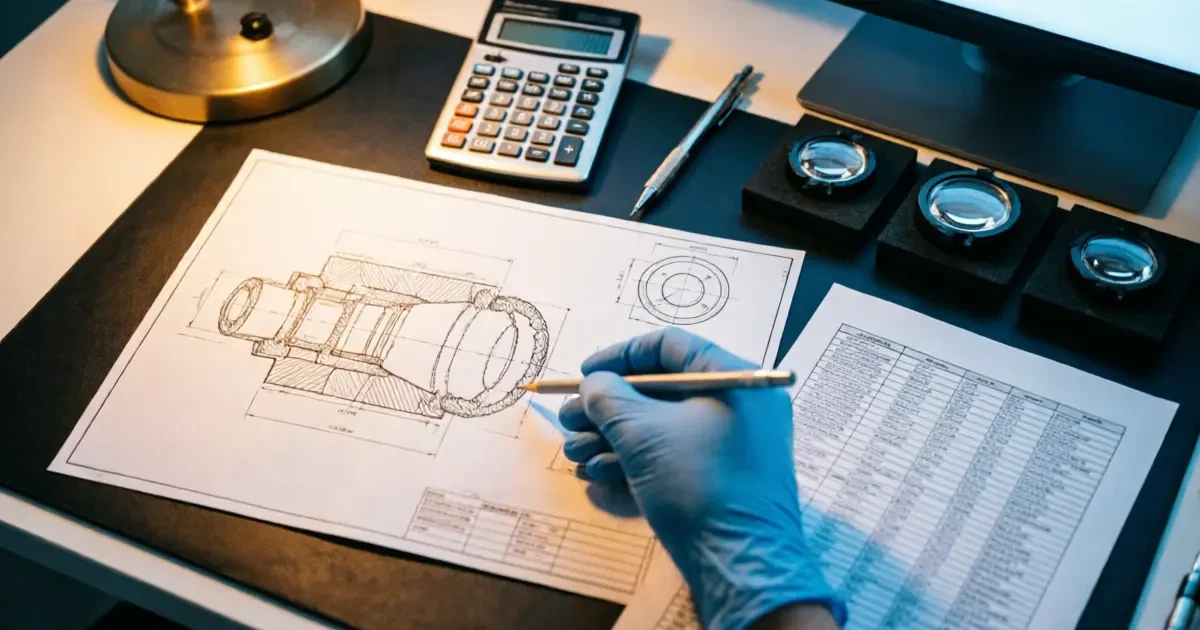
Design-for-manufacture reviews are often performed by people who will not manufacture the part, which limits them to generic comments. When the reviewer runs the polishing cell that will make the surface, the comments become specific: this radius-to-aperture ratio will need a smaller tool and an extra figuring iteration; this wedge allowance is tighter than the centration fixture can hold; this coating band sits where the substrate has an absorption edge and the target reflectance is unrealistic.
That specificity is worth more than any general checklist. Our design services team runs the review against actual process capability, using the same tolerance grades that appear on the drawing, so the outcome is a set of achievable limits rather than a list of concerns.
Coating and metrology are the two steps most often outsourced, and the two that hurt most
Coating is where a finished optical surface is most exposed. A part that leaves the polisher at 10/5 can return at 40/20 if handling between sites is poor, and the receiving inspection will record the defect without being able to identify its cause. Coating in-house means the part moves from polish to coating under one handling discipline, and any surface degradation is traceable to a step rather than to a shipment.
Metrology has a similar property. If the final inspection is performed by a third party, disagreements about aperture, wavelength or mounting are resolved by correspondence. With the interferometer, autocollimator, spectrophotometer and centration tester in the same facility as the process, a marginal part is re-measured under a second configuration immediately, and the question "is this part acceptable" is answered by data rather than by position. The instruments and the reports we issue are described on the manufacturing page.
Schedule behaves differently
In a split chain, the critical path is the sum of the queue times at each supplier plus the transport between them. Queue times are the dominant term and the least visible: a two-week polishing slot plus a two-week coating slot plus shipping is six weeks before any technical difficulty is counted. Integration removes transport and collapses hand-offs, which is why prototype quantities of custom optics typically ship in 2–3 weeks and production volumes of a hundred pieces or more in 4–6 weeks.
Integration also allows re-sequencing. If a coating run is not ready, the next polishing batch can move forward; if a design change arrives, the affected operation can be rescheduled without renegotiating a purchase order. That flexibility is worth little in a stable programme and a great deal in one that is still converging, which describes most first-article work.
What integration does not solve
It does not remove process limits, and it does not make an impossible tolerance possible. A λ/20 surface on a 200 mm aperture is still a difficult part whether or not the polishing cell is next door. It also does not remove the need for a specification: an integrated supplier with an ambiguous drawing will still deliver something, and the something may not be what the designer intended.
Nor does it replace supplier management for materials. Substrates are purchased, and material lead time — particularly for CaF2, sapphire and infrared crystals — remains outside the facility's control. The benefit is that material availability is known at quotation rather than discovered at machining.
How to use an integrated supplier well
- Send the design intent as well as the drawing: the function, the band and the sensitivity of each parameter.
- Ask for a manufacturability review before the drawing is frozen, and take the comments seriously.
- Declare volume ramp and schedule pressure at quotation, since both change the process choice.
- Agree the inspection plan at the same time as the tolerance, so acceptance is defined before first article.
- Keep one technical contact for the programme; the value of integration is lost if requirements arrive through four channels.
Programmes that follow this pattern spend their early effort on the drawing rather than on concessions. That is the practical meaning of vertical integration in custom optics: fewer places for a requirement to be lost, and a shorter loop between a measurement and the process change it implies. Our OEM/ODM programmes are structured around that loop, from prototype through series production under one quality system.
Have a programme that needs design and manufacturing in one place? Send your drawing, specification or beam profile and our engineering team will review it and reply with a quotation.Start a project conversation
Frequently Asked Questions
Does in-house manufacturing mean I cannot use my preferred material?
No. Substrates are purchased from qualified material suppliers, including Schott, Ohara and CDGM glasses as well as crystal vendors. Integration covers the process steps — grinding, polishing, turning, molding, coating, cementing and metrology — not the material supply chain.
How does integration affect the price of a small prototype order?
Prototype pricing is dominated by set-up and figuring iterations rather than by material, so integration mostly affects schedule and the number of iterations rather than the unit price. Where it does reduce cost is in avoided rework and avoided re-quotation after a failed first article.
Can you take over a design that was previously made elsewhere?
Yes, and it is a common starting point. We review the existing drawing, confirm the critical parameters against our process capability, and identify any requirement that was achievable in the previous process but is not transferable. That review usually happens before the first order rather than after the first rejection.
What quality system covers the integrated processes?
All in-house processes run under one ISO 9001:2015 quality management system, with incoming material inspection, in-process control and final inspection. Certification, inspection records and certificates of conformity are issued against that system.
Does integration shorten coating lead time specifically?
It shortens the hand-off rather than the deposition itself. A coating run still has a fixed cycle, but the part does not wait in transit or in a receiving queue, and a spectral miss can be re-run without a new purchase order. For programmes with several coated elements, that difference compounds across the batch.